In This Article
On December 29, 1921, the Banca Italiana di Sconto (BIS)—Italy’s third-largest commercial bank, boasting more than 170 branches across the peninsula and abroad, chaired by Nobel laureate Guglielmo Marconi and directed by managing partner Angelo Pogliani—closed its doors and petitioned the Tribunal of Rome for a statutory moratorium on payments. With deposit and interbank liabilities exceeding 4.3 billion lire, the collapse of the Banca Italiana di Sconto stood as the largest bank failure in interwar Europe prior to the 1931 Central European crisis. Dragged down by its captive lending relationship with the Genoa-based steel, engineering, and shipbuilding conglomerate Gio. Ansaldo & C. controlled by brothers Pio and Mario Perrone, the failure of the BIS exposed the structural fragility of Italy’s universal mixed-banking model (banca mista). Within months, Prime Minister Ivanoe Bonomi’s refusal to rescue the BIS contrasted sharply with the secret November 1922 decision by newly installed Prime Minister Benito Mussolini and Bank of Italy Director General Bonaldo Stringher to deploy the Special Autonomous Section of the Consorzio per Sovvenzioni su Valori Industriali (CSVI) to bail out the politically connected, Vatican-aligned Banco di Roma. [1]

Wartime Nationalism, the Perrone Brothers, and the Birth of the “Banca Italianissima”
Before the First World War, Italy’s industrial credit system was dominated by two major German-style universal banks launched in the 1890s: the Milan-based Banca Commerciale Italiana (COMIT) and the Genoa- and Milan-based Credito Italiano (CREDIT), alongside the Catholic-oriented Banco di Roma. Since assuming control of the Genoese engineering firm Gio. Ansaldo & C. after their father Ferdinando Maria Perrone’s death in 1908, brothers Pio and Mario Perrone had clashed repeatedly with COMIT, which financed Ansaldo’s archival steel and armaments competitors in the Terni-Vickers group and Ilva. [2]
Convinced that Italian heavy industry needed a dedicated national bank free of German, Austrian, or rival Milanese influence, the Perrone brothers backed the December 30, 1914 formation of the Banca Italiana di Sconto—created through the merger of the Società Bancaria Italiana and the Società Italiana di Credito Provinciale with an initial share capital of 15 million lire, rapidly raised to 70 million lire in 1915 and 315 million lire by 1919. Appointed chairman to lend international prestige and patriotic appeal, Guglielmo Marconi presided over an institution marketed during the war as the banca italianissima (“most Italian bank”), while financier Angelo Pogliani managed day-to-day operations. [3]
During Italy’s wartime mobilization from 1915 to 1918, Ansaldo expanded into a vertically integrated colossus encompassing iron mines in Cogne, hydroelectric plants, steelworks at Cornigliano, shipyards in Sestri Ponente, aircraft factories, and locomotive works. Its workforce swelled from roughly 6,000 employees in 1914 to more than 80,000 (and over 110,000 across affiliated enterprises) by 1918, while its share capital leaped from 30 million lire to 500 million lire. To finance this breakneck expansion, the Perrone brothers turned the Banca Italiana di Sconto into Ansaldo’s captive house treasury. Relying on patriotic deposit campaigns and emigrants’ remittances across North and South America, the BIS expanded its deposits from 355 million lire in 1915 to over 4.5 billion lire by 1920, funneling well over half of its commercial credit portfolio into Ansaldo and its satellite companies. [4]
The 1918–1920 “Bank Wars” and the Post-WWI Industrial Slump
Rather than retrenching when wartime munitions contracts ended in November 1918, Pio and Mario Perrone attempted an audacious Reverse-Engineering of Italian finance: using industrial profits and bank credit to seize control of their rival universal banks. In March 1918 and again in March 1920, the Perrone brothers quietly accumulated shares in the Banca Commerciale Italiana (COMIT), attempting a hostile takeover that would have placed Italy’s two largest industrial credit networks under Ansaldo’s command. [5]
Known in Italian financial history as the “Parallel Wars” or “Bank Wars” (scalate bancarie)—mirrored simultaneously by Turin industrialist Riccardo Gualino and Giovanni Agnelli’s attempted raid on Credito Italiano—the Perrone brothers’ bid failed when COMIT managing director Giuseppe Toeplitz organized a defensive syndicate (*Consorzio Mobiliare Finanziario*, or COMOFIN) that locked voting control of COMIT inside a holding shield in 1920. Worse still for Ansaldo and the BIS, acquiring massive blocks of COMIT shares at peak prices immobilized hundreds of millions of lire in liquid funds just as the global post-war recession of 1920–1921 struck. [6]
As maritime freight rates collapsed, state orders vanished, and raw material prices plunged, Ansaldo’s uncompleted merchant ships, Cogne steel mills, and engineering inventories turned into illiquid deadweight. By mid-1921, Ansaldo owed the Banca Italiana di Sconto and affiliated syndicates more than 1.5 billion lire directly and indirectly, yet could neither sell equity nor service its short-term bills. [7]
The November 1921 Rescue Consortium and the December 29 Moratorium
By autumn 1921, rumors of Ansaldo’s insolvency triggered an accelerating run on the branches of the Banca Italiana di Sconto. Alarmed by the threat of a systemic panic, Bank of Italy Director General Bonaldo Stringher and Prime Minister Ivanoe Bonomi’s government pressured COMIT, Credito Italiano, and the Banco di Roma on November 24, 1921 to join the three banks of issue (Bank of Italy, Banco di Napoli, and Banco di Sicilia) in forming an emergency syndicate under the Consorzio per Sovvenzioni su Valori Industriali (CSVI)—an institution originally established in December 1914 to discount industrial paper during the war. [8]
The November 1921 relief pool provided an initial ceiling of 600 million lire in emergency liquidity against Ansaldo’s pledged securities, conditioned on the immediate resignation of Pio and Mario Perrone from Ansaldo’s helm in early December 1921. Yet 600 million lire proved wholly inadequate against the scale of the run. Domestic and foreign depositors withdrew over 1.5 billion lire from the BIS during the final months of 1921, while rival bankers at COMIT and Credito Italiano refused to commit further private capital to rescue the institution that had tried to raid them eighteen months earlier.
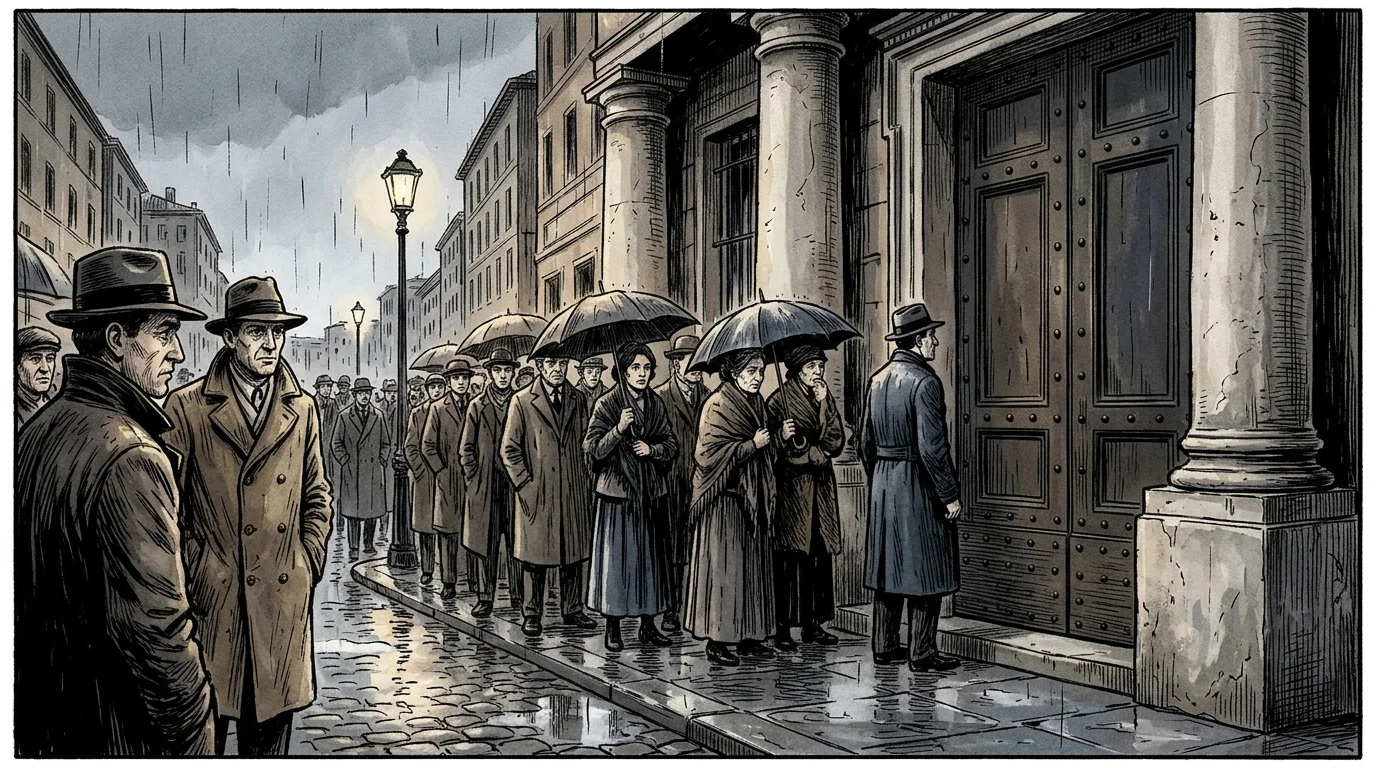
When Angelo Pogliani appealed to Prime Minister Ivanoe Bonomi for an unconditional state guarantee in late December 1921—and liberal economist Luigi Einaudi argued forcefully in the pages of Corriere della Sera that taxpayer money must not be used to socialize the speculative losses of the Perrone brothers—the cabinet declined an open-ended bailout. On December 29, 1921, the Banca Italiana di Sconto suspended payments under a revived wartime moratorium decree. At the time of its closure, the bank held roughly 4.3 billion lire in deposits and creditor claims against heavily impaired industrial advances, leaving hundreds of thousands of small savers, Southern Italian emigrants, and medium-sized businesses with frozen accounts.
Under a judicial concordat finalized in March 1922, creditors without small-deposit priority received roughly 62 to 67 percent of their claims in a mix of staggered cash installments and equity shares in a newly formed successor bank, the Banca Nazionale di Credito, while Ansaldo’s viable shipyards and engineering plants were carved out into a restructured company under the control of the Bank of Italy and CSVI.
The CSVI Special Autonomous Section and the 1922–1923 Bailout of Banco di Roma
The liquidation of the Banca Italiana di Sconto did not end the crisis; instead, depositor panic immediately migrated to Italy’s remaining vulnerable universal bank, the Banco di Roma. Deeply tied to the Vatican, the aristocratic Roman real estate sector, and Mussolini’s emerging political supporters, the Banco di Roma had expanded aggressively across the Mediterranean and the Levant while accumulating over 1.5 billion lire in non-performing industrial, mining, and agricultural loans.
To prevent a second catastrophic failure, royal decrees issued in March 1922 created the Special Autonomous Section of the CSVI (Sezione Speciale Autonoma del Consorzio per Sovvenzioni su Valori Industriali). Unlike the ordinary CSVI, the Special Autonomous Section could discount bills directly with the Bank of Italy beyond normal statutory ceilings—effectively allowing Bonaldo Stringher to print central bank money to absorb frozen industrial and banking assets, Initially capped at 1 billion lire in March 1922, this ceiling was rapidly removed as the crisis deepened.
When Benito Mussolini became Prime Minister at the end of October 1922 following the March on Rome, the Banco di Roma stood days away from suspending payments. Whereas the liberal Bonomi cabinet had allowed the Banca Italiana di Sconto to fail eleven months earlier, Mussolini and Finance Minister Alberto De’ Stefani concluded that the collapse of the Banco di Roma would shatter the new regime’s domestic prestige and alienate the Catholic Church. In November 1922, Mussolini instructed Stringher to execute a covert, full-scale rescue of the Banco di Roma.
Through a series of confidential agreements concluded between November 1922 and November 1923, the Special Autonomous Section of the CSVI pumped more than 2 billion lire into the Banco di Roma, transferring its toxic industrial holdings into a dedicated state-backed bad bank, the Società Finanziaria Industriale Italiana (SOFINDIT). By the time the Special Autonomous Section was converted into the Istituto di Liquidazioni in 1926, the Bank of Italy’s total net advances for the BIS-Ansaldo liquidation and the Banco di Roma rescue exceeded 4.1 billion lire—representing nearly a quarter of the entire Italian monetary base. By establishing the precedent that politically strategic universal banks were “too big to fail” while leaving the mixed-banking model intact for another decade, the 1921–1923 rescues set the stage for the even larger 1931–1933 crisis that forced the creation of the Istituto Mobiliare Italiano (IMI) and the Istituto per la Ricostruzione Industriale (IRI), permanently ending mixed banking in Italy under the Banking Law of 1936.
Theoretical & Balance-Sheet Transmission Mechanism
In the Kindleberger–Minsky taxonomy of financial instability (Kindleberger, 1978; Minsky, 1986) and Irving Fisher’s (1933) debt-deflation framework, speculative asset booms become systemic crises when credit expansion shifts balance sheets from hedge finance (cash flows covering principal and interest) to speculative and Ponzi finance (relying on rising asset prices and short-term margin roll-overs).
Once monetary tightening or an exogenous shock halts price appreciation, forced margin liquidations trigger Fisherian debt-deflation: fire-sale asset discounts erode bank collateral values, contracting credit supply across the real economy.
Sources and Further Reading
- Luigi Einaudi, “Le ragioni dell’intervento dello stato (la crisi della Banca di sconto),” Corriere della Sera / Fondazione Luigi Einaudi, 1922-01-03. Historical & Financial Reference
- Franco Bonelli, “STRINGHER, Bonaldo,” Dizionario Biografico degli Italiani (Treccani), 2019. Historical & Financial Reference
- Gianni Toniolo, “The Bank of Italy: A Short History, 1893–1998,” Cambridge University Press, 2018. Peer-Reviewed / Academic Research
- Anna Maria Falchero, “Banchieri e politici. Nitti e il gruppo Ansaldo-Banca Italiana di Sconto,” Italia Contemporanea / Istituto Nazionale Ferruccio Parri, 1982. Historical & Financial Reference
- Archivio Storico Intesa Sanpaolo, “Istituto Mobiliare Italiano (IMI) and the Restructuring of Italian Mixed Banking,” Intesa Sanpaolo Historical Archives, 2019. Historical & Financial Reference
- Centro Einaudi / Reforming.it, “Le crisi bancarie in Italia tra Ottocento e Novecento: Banca Italiana di Sconto, Ansaldo e Banco di Roma,” Reforming.it, 2016. Historical & Financial Reference
- Irving Fisher — "The Debt-Deflation Theory of Great Depressions," Econometrica 1, no. 4 (FRASER Federal Reserve Archive, 1933): 337–357 Central Bank / Monetary Authority
- Charles P. Kindleberger & Robert Z. Aliber — Manias, Panics, and Crashes: A History of Financial Crises (Palgrave Macmillan) Peer-Reviewed / Academic Research
Cite This Historical Dossier (APA / Chicago)
APA (7th ed.): Ç., S. (Ed.). (2026). The 1921 Collapse of Banca Italiana di Sconto, Ansaldo, and the Bailout of Banco di Roma. In Forgotten Fortunes Historical Monograph Series (Forgotten Fortunes Editorial Desk). https://forgottenfortunes.net/banca-italiana-di-sconto-1921/
MLA (9th ed.): Ç., Soner, ed. "The 1921 Collapse of Banca Italiana di Sconto, Ansaldo, and the Bailout of Banco di Roma." Forgotten Fortunes: Financial & Monetary History Archive, 2026, https://forgottenfortunes.net/banca-italiana-di-sconto-1921/.
Chicago (17th ed.): Ç., Soner, ed. "The 1921 Collapse of Banca Italiana di Sconto, Ansaldo, and the Bailout of Banco di Roma." Forgotten Fortunes Historical Monograph Series (Forgotten Fortunes Editorial Desk), September 19, 2026. https://forgottenfortunes.net/banca-italiana-di-sconto-1921/.
Have an idea for another financial history documentary or article? Request a story →