In This Article
On Monday, July 13, 1931, the Darmstädter und Nationalbank—universally known as the Danatbank and standing as one of Weimar Germany’s four most powerful joint-stock universal banks—failed to open its counters for business. Triggered by a relentless drain of short-term foreign deposits and the catastrophic RM 200 million bankruptcy of the Bremen textile conglomerate Norddeutsche Wollkämmerei und Kammgarnspinnerei (Nordwolle), Danatbank’s collapse ignited a full-scale “twin crisis” of the German banking system and the Reichsmark. Within forty-eight hours, Chancellor Heinrich Brüning and Reichsbank President Hans Luther were forced to declare a nationwide bank holiday, close the German stock exchanges for months, create the state-backed Akzept- und Garantiebank, nationalize and merge Danatbank into Dresdner Bank, and erect comprehensive foreign-exchange controls (Devisenbewirtschaftung) that effectively ended Germany’s adherence to the classical gold exchange standard. [1]
Structural Fragility: Weimar Banks and Short-Term Foreign Debt After 1924
The roots of the July 1931 banking panic lay in the fragile reconstruction of the German financial system after the hyperinflation of 1922–1923. Although the 1924 Dawes Plan and the introduction of the gold-backed Reichsmark stabilized the currency at 4.20 Reichsmarks to the U.S. dollar, hyperinflation had wiped out the domestic savings base of the German middle class and eroded the equity buffers of the Berlin great banks (Großbanken). While major German banks had maintained capital-to-asset ratios of nearly 20 percent before the First World War, by 1930 the equity ratios of the largest Berlin universal banks had fallen to between 6 and 8 percent, exaggerated further by their secret practice of repurchasing their own shares on the stock exchange to prop up market quotations. [2]
Starved of long-term domestic capital yet eager to finance industrial rationalization and municipal spending, German banks turned heavily to short-term foreign borrowing in London, New York, Amsterdam, and Zurich. Between 1925 and 1930, Germany accumulated roughly RM 25.5 billion in total foreign liabilities, of which approximately RM 14.8 billion consisted of short-term credits maturing in ninety days or less. By the end of 1930, short-term foreign deposits—primarily denominated in U.S. dollars and British pounds sterling—accounted for more than 40 percent of all deposits held at the big Berlin universal banks. Crucially, the banks engaged in acute maturity and currency transformation: borrowing short-term foreign currency from Anglo-American and Swiss money markets and lending those funds long-term in Reichsmarks to heavily indebted German industrial enterprises. [3]
| Documented Figure / Metric | Historical Significance & Archival Context |
|---|---|
| RM 60 million | Operating with just RM 60 million in stated share capital and RM 60 million in published reserves, Danatbank had relied heavily on short-term foreign interbank funds to build concentrated credit positions in major German industrial groups. |
| RM 48 million | Danatbank alone had lent roughly RM 48 million to RM 50 million directly to Nordwolle, a single-borrower exposure equivalent to more than 40 percent of Danatbank's entire equity capital, while Dresdner Bank held another RM 25 million in claims. |
| 20 percent | By the afternoon of July 13, long queues had formed outside commercial banks and municipal savings banks (Sparkassen) across Germany, forcing institutions to ration cash payouts to 10 or 20 percent of requested withdrawals. |
The Creditanstalt Shock, Reparations Politics, and the Run on the Reichsmark
This precarious structure began to fracture in September 1930, when Reichstag elections delivered a dramatic surge for the Nazi and Communist parties, prompting an initial wave of foreign capital flight. The decisive external shock arrived on May 11, 1931, when Austria’s largest bank, the Vienna-based Creditanstalt, disclosed devastating loan losses that wiped out most of its capital. Although Berlin banks held relatively modest direct claims on Vienna, international creditors immediately questioned the solvency of Central European universal banks operating under identical balance-sheet structures. [4]
In early June 1931, Chancellor Heinrich Brüning compounded the market’s anxiety by issuing a harsh domestic austerity decree accompanied by a public manifesto declaring that Germany had reached the absolute limit of its capacity to pay reparations under the 1929 Young Plan. Foreign creditors interpreted Brüning’s statement as a warning that private cross-border credits might also be frozen. Between late May and June 20, 1931, the Reichsbank lost more than RM 1 billion in gold and foreign-exchange reserves—over 40 percent of its entire reserve stock—as commercial banks scrambled to convert Reichsmarks at the central bank to repay fleeing foreign depositors. [5]
Even after U.S. President Herbert Hoover proposed a one-year moratorium on intergovernmental war debts and reparations on June 20, 1931, French diplomatic objections delayed final agreement until July 6. By then, the Reichsbank’s statutory reserve coverage ratio—which legally required gold and foreign currency holdings equal to at least 40 percent of banknotes in circulation—had fallen to the brink of the 40 percent floor despite a raised 7 percent discount rate and an emergency US$100 million (RM 420 million) central-bank bridge loan extended on June 25 by the Bank of England, the Federal Reserve Bank of New York, the Bank of France, and the Bank for International Settlements (BIS). [6]
Nordwolle’s RM 200 Million Insolvency and the Fall of Danatbank
Among the Berlin Großbanken, none had pursued aggressive industrial expansion more relentlessly than the Darmstädter und Nationalbank, formed by a 1922 merger and led by its flamboyant managing partner Jacob Goldschmidt. Operating with just RM 60 million in stated share capital and RM 60 million in published reserves, Danatbank had relied heavily on short-term foreign interbank funds to build concentrated credit positions in major German industrial groups. Its single largest borrower was Norddeutsche Wollkämmerei und Kammgarnspinnerei (Nordwolle), a Bremen-based wool-combing and worsted-spinning conglomerate run by the Lahusen family. [7]
Gambling that global wool prices would rebound during the late 1920s, the Lahusen brothers had accumulated vast inventories of raw wool while concealing operating losses through fictitious transfers to Dutch and overseas subsidiaries. As raw wool prices plummeted during the Great Depression, Nordwolle’s hidden deficit spiraled out of control. In mid-June 1931, an external audit revealed that Nordwolle had lost more than RM 200 million—wiping out its entire RM 75 million share capital and reserves more than twice over. Danatbank alone had lent roughly RM 48 million to RM 50 million directly to Nordwolle, a single-borrower exposure equivalent to more than 40 percent of Danatbank’s entire equity capital, while Dresdner Bank held another RM 25 million in claims. [8]
As rumors of Nordwolle’s impending bankruptcy filing swept international financial centers in late June and early July, foreign and domestic depositors singled out Danatbank. Between May and July 11, 1931, Danatbank lost roughly RM 650 million—more than 40 percent of its total deposits. To survive, Danatbank rediscounted virtually its entire portfolio of eligible commercial bills at the Reichsbank. By early July, however, the Reichsbank had exhausted its own free gold reserves and imposed strict credit rationing, refusing to discount bills that lacked genuine commercial backing. After Reichsbank President Hans Luther returned empty-handed from a desperate weekend flight to London, Paris, and Basel seeking a new international central-bank loan, Goldschmidt informed the cabinet on the weekend of July 11–12 that Danatbank had run out of liquid assets and rediscountable bills. When Rival Deutsche Bank und Disconto-Gesellschaft refused to guarantee Danatbank’s obligations without full state indemnification, Danatbank’s doors stayed shut on the morning of July 13, 1931.
The July 14–15 Bank Holiday, Dresdner Bank’s Contagion, and the Akzeptbank
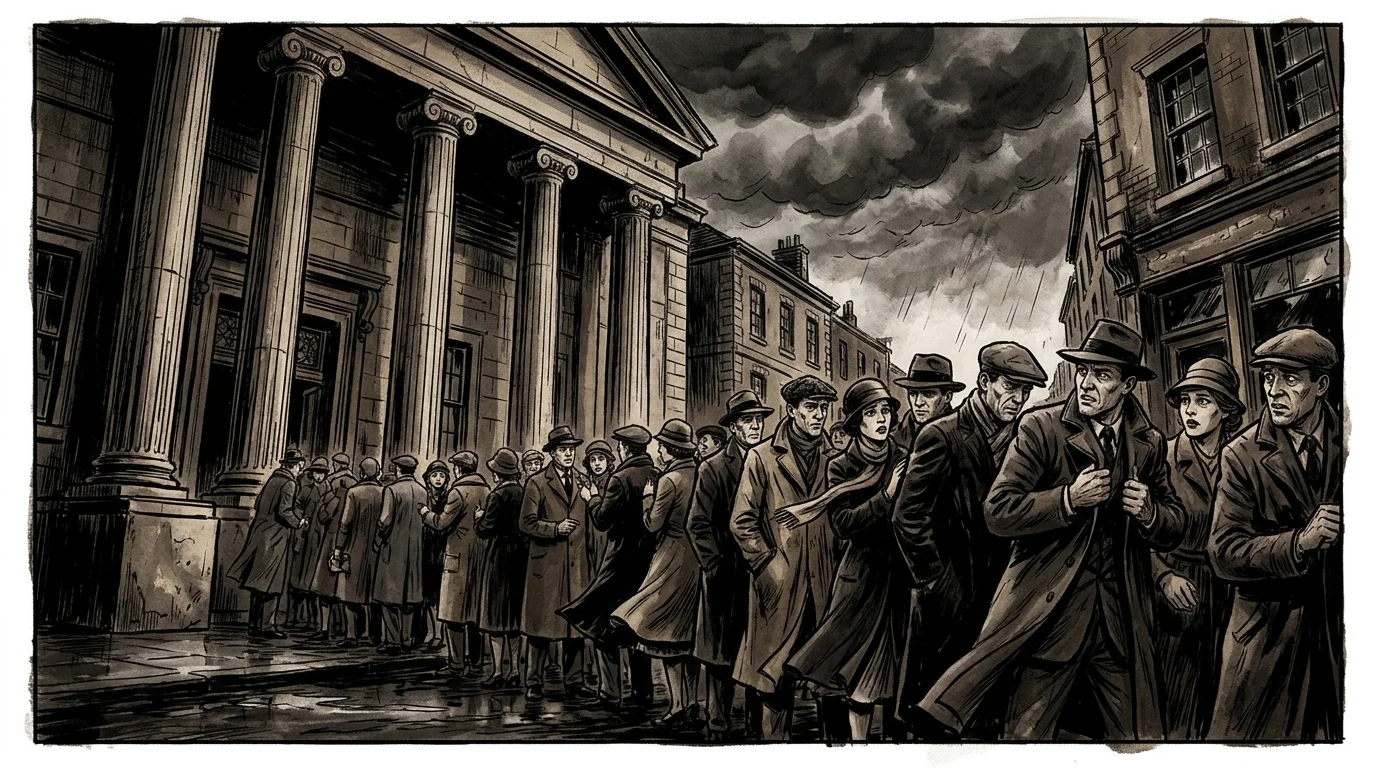
Danatbank’s closure on July 13 immediately triggered a nationwide retail run on all remaining financial institutions, above all Dresdner Bank, Germany’s third-largest universal bank, which had also suffered heavy foreign withdrawals and Nordwolle losses. By the afternoon of July 13, long queues had formed outside commercial banks and municipal savings banks (Sparkassen) across Germany, forcing institutions to ration cash payouts to 10 or 20 percent of requested withdrawals. That evening, Dresdner Bank informed the Reich Chancellery that it too was illiquid.
Acting under Article 48 of the Weimar Constitution, President Paul von Hindenburg and Chancellor Brüning declared Tuesday, July 14, and Wednesday, July 15, 1931, to be general national bank holidays (Bankfeiertage) and ordered the indefinite closure of German stock exchanges. Even after the formal two-day holiday ended, cash withdrawals and interbank transfers remained tightly restricted for three weeks until normal domestic payments resumed on August 5, 1931, accompanied by a punitive 10 percent Reichsbank discount rate and a 15 percent Lombard rate.
Because the Reichsbank was prohibited by its 1924 statutory charter from discounting pure finance bills lacking a third commercial signature, the government and the Reichsbank joined with healthy banks and industrial firms on July 28, 1931, to establish a special liquidity conduit: the Akzept- und Garantiebank AG (Acceptance and Guarantee Bank), capitalized at RM 200 million with the Reich assuming a 40 percent stake. By placing its statutory endorsement—the missing third signature—on promissory notes issued by illiquid commercial banks and the central giro institutions of the savings banks, the Akzeptbank transformed frozen bank loans into eligible bills that the Reichsbank could legally discount, injecting more than RM 1.5 billion in emergency central-bank liquidity into the banking system.
De Facto Bank Nationalization, Standstill Agreements, and Exchange Controls
To restore solvency to the shattered universal banks, the Brüning cabinet carried out a massive state recapitalization that effectively nationalized the core of German commercial banking. Under emergency decrees issued between July 1931 and early 1932, the Reich and the Reichsbank’s Golddiskontbank injected RM 300 million in preference shares into Dresdner Bank, taking over 91 percent of its equity. In March 1932, the insolvent Danatbank was formally merged into the state-controlled Dresdner Bank, while Commerz- und Privat-Bank and the regional Allgemeine Deutsche Credit-Anstalt (ADCA) also came under majority public ownership, and even the flagship Deutsche Bank und Disconto-Gesellschaft required over one-third public participation.
Externally, the Brüning government abandoned free capital mobility rather than devalue the nominal parity of the Reichsmark. Through emergency decrees beginning on July 15 and July 18, 1931, Berlin instituted strict foreign-exchange controls (Devisenbewirtschaftung), centralizing all foreign currency dealings at the Reichsbank and requiring exporters to surrender foreign-exchange earnings. Simultaneously, at a conference in Basel in August 1931, foreign creditor banks signed the first German Standstill Agreement (Stillhalteabkommen), freezing roughly RM 6.3 billion in short-term cross-border bank credits in exchange for continued interest payments. Finally, on September 19, 1931, the government created Germany’s first comprehensive banking supervisory authority—the Reich Commissioner for the Banking Sector (Reichskommissar für das Bankgewerbe)—laying the institutional foundation for the Reich Banking Act (Kreditwesengesetz) of December 1934.
Theoretical & Balance-Sheet Transmission Mechanism
In the Kindleberger–Minsky taxonomy of financial instability (Kindleberger, 1978; Minsky, 1986) and Irving Fisher’s (1933) debt-deflation framework, speculative asset booms become systemic crises when credit expansion shifts balance sheets from hedge finance (cash flows covering principal and interest) to speculative and Ponzi finance (relying on rising asset prices and short-term margin roll-overs).
Once monetary tightening or an exogenous shock halts price appreciation, forced margin liquidations trigger Fisherian debt-deflation: fire-sale asset discounts erode bank collateral values, contracting credit supply across the real economy.
Sources and Further Reading
- Isabel Schnabel, “ The German Twin Crisis of 1931,” The Journal of Economic History, Vol. 64, No. 3, Cambridge University Press, 2004. Peer-Reviewed / Academic Research
- Harold James, “ The Causes of the German Banking Crisis of 1931,” The Economic History Review, Vol. 37, No. 1, 1984. Peer-Reviewed / Academic Research
- Isabel Gödde (Schnabel), “ Liquidity and Contagion: The Crisis of 1931 in Germany,” University of Mannheim Sonderforschungsbereich 504 Discussion Paper No. 02-48, 2002. Historical & Financial Reference
- Wissenschaftliche Dienste des Deutschen Bundestages, “ Von der Bankenkrise 1931 zur Bankenenquete 1933 (WD 1 – 3000 – 002/17),” Deutscher Bundestag, 2017. Historical & Financial Reference
- Christopher Kopper, “ New Perspectives on the 1931 German Banking Crisis and Its Aftermath,” Jahrbuch für Wirtschaftsgeschichte / Economic History Yearbook, Vol. 52, No. 2, 2011. Historical & Financial Reference
- Matthew Baron, Emil Verner, and Wei Xiong, “ Banking Crises Without Panics,” National Bureau of Economic Research (NBER Working Paper No. 26908), 2020. Peer-Reviewed / Academic Research
- Irving Fisher — "The Debt-Deflation Theory of Great Depressions," Econometrica 1, no. 4 (FRASER Federal Reserve Archive, 1933): 337–357 Central Bank / Monetary Authority
- Charles P. Kindleberger & Robert Z. Aliber — Manias, Panics, and Crashes: A History of Financial Crises (Palgrave Macmillan) Peer-Reviewed / Academic Research
Cite This Historical Dossier (APA / Chicago)
APA (7th ed.): Ç., S. (Ed.). (2026). The July 1931 German Banking Crisis, Danatbank's Collapse, and Exchange Controls. In Forgotten Fortunes Historical Monograph Series (Forgotten Fortunes Editorial Desk). https://forgottenfortunes.net/germany-1931-danatbank-crisis/
MLA (9th ed.): Ç., Soner, ed. "The July 1931 German Banking Crisis, Danatbank's Collapse, and Exchange Controls." Forgotten Fortunes: Financial & Monetary History Archive, 2026, https://forgottenfortunes.net/germany-1931-danatbank-crisis/.
Chicago (17th ed.): Ç., Soner, ed. "The July 1931 German Banking Crisis, Danatbank's Collapse, and Exchange Controls." Forgotten Fortunes Historical Monograph Series (Forgotten Fortunes Editorial Desk), September 9, 2026. https://forgottenfortunes.net/germany-1931-danatbank-crisis/.
Have an idea for another financial history documentary or article? Request a story →