In This Article
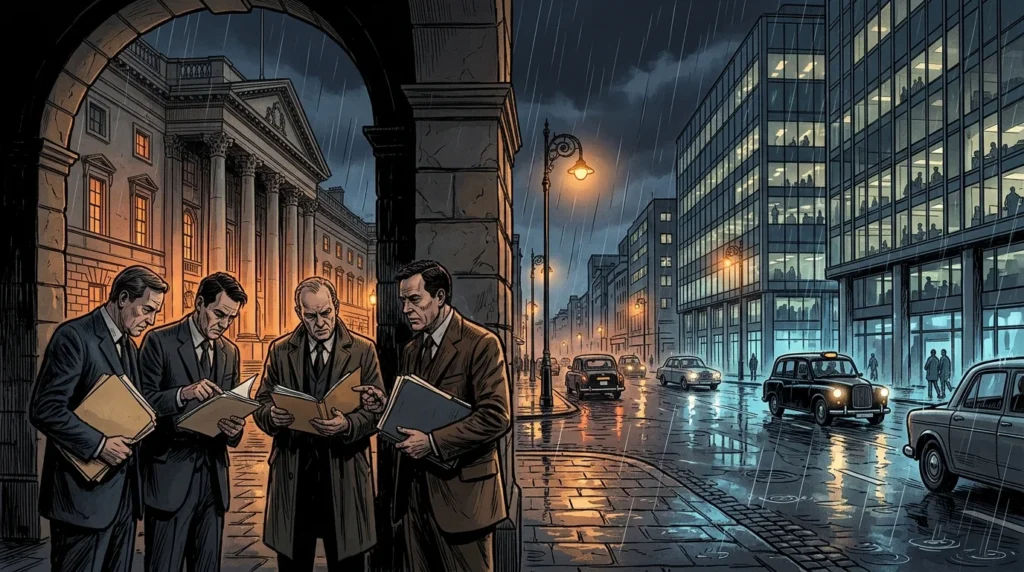
Between 1966 and 1985, the Republic of Ireland experienced two extraordinary tests of financial stability that have fascinated monetary economists and central bankers ever since. The first was a series of three nationwide labor disputes led by the Irish Bank Officials’ Association (IBOA) in 1966, 1970, and 1976 that padlocked the doors of Ireland’s clearing banks for three months, six and a half months, and two months respectively—the longest commercial banking shutdowns in modern Western economic history. Deprived of formal payment clearing and vault cash during the 1970 strike, Irish citizens, 12,000 retail shops, and roughly 11,000 country and neighborhood pubs spontaneously constructed a decentralized, trust-based credit system that circulated and eventually cleared roughly £5 billion in undated and post-dated paper cheques. Fifteen years later, after the Central Bank Act 1971 modernized bank licensing, Ireland confronted its first modern prudential banking crisis in March 1985 when Allied Irish Banks’ (AIB) newly acquired subsidiary, the Insurance Corporation of Ireland (ICI), collapsed under more than IR£200 million in hidden London reinsurance losses—forcing Taoiseach Garret FitzGerald’s government to nationalize ICI over the St. Patrick’s Day weekend to prevent a catastrophic run on Ireland’s largest commercial bank. [1]
The 1966 Bank Closure and Its Macroeconomic Shock
In the mid-1960s, the Irish banking landscape was dominated by the “Associated Banks”—a cartel of retail clearing institutions that was in the process of consolidating into two domestic giants, Bank of Ireland and Allied Irish Banks (AIB), alongside two Belfast-headquartered clearing banks, Ulster Bank and Northern Bank. Together, the Associated Banks operated more than 99 percent of commercial bank branches in the Republic and held the overwhelming majority of household and corporate current and deposit accounts, while a handful of non-unionized North American and merchant “Non-Associated Banks” operated just seven branches in Dublin, Cork, and Limerick. [2]
Industrial relations between the Associated Banks and their unionized staff, represented by the Irish Bank Officials’ Association (IBOA), deteriorated sharply in late 1964 when rumors of an impending strike sparked a pre-emptive depositor run. In April 1966, after negotiations broke down over inflationary cost-of-living erosion and low starting pay for junior clerks, the IBOA called a “selective strike” of the 3,400 bank officials (out of 7,800 total staff) who had entered service after January 1, 1959. Contending that branches could not function without junior tellers and bookkeepers, the Irish Banks’ Standing Committee (IBSC) locked out the remaining 4,400 employees and shut all Associated Bank branches across the Republic at 3:00 p.m. on May 5, 1966. [3]
The 1966 strike lasted three months, with banks reopening to the public on August 5, 1966 after employers conceded an immediate 7.5 percent salary increase, a further 3.5 percent raise in April 1967, and improved promotion tracks for women and junior officials. Although contemporary commentary marvelled that Irish commerce had not collapsed completely, modern cliometric analysis using synthetic control methods by economists Jason Lennard, Seán Kenny, and Emma Horgan demonstrates that the 1966 closure inflicted a severe macroeconomic drag: Irish economic activity stagnated and deviated by 6.1 percent below its counterfactual growth trajectory, as firms and households expended substantial time and working capital hoarding cash, ferrying notes from Britain, and rationing trade credit. [4]
| Documented Figure / Metric | Historical Significance & Archival Context |
|---|---|
| £61 million | By early 1985, internal reviews revealed that ICI was insolvent, with initial loss estimates jumping from IR£61 million past IR£100 million—and eventually calculated by High Court administrator William McCann of Craig Gardner at nearly IR£300 million (over IR£226 million in net deficit). |
| 100 percent | The Minister for Industry, Trade, Commerce and Tourism acquired 100 percent of ICI's shares from AIB for a nominal sum through a state holding company, Sealúchais Árachais Teoranta, and petitioned the High Court to place ICI into statutory administration under William McCann pursuant to the Insurance (No. |
The Six-and-a-Half-Month 1970 Strike and the “Pub Clearing” Economy
An even more dramatic monetary experiment began on May 1, 1970, when a fresh IBOA dispute over salary scales and overtime shut all four Associated Banks—Bank of Ireland, Allied Irish Banks, Ulster Bank, and Northern Bank—for six and a half months until November 17, 1970. Because the Associated Banks controlled roughly 85 percent of the Republic’s broad money supply in current and deposit accounts, the closure instantly froze formal check clearing and cut off access to bank vaults across the country. Businesses scrambled to ship currency notes across the Irish Sea from British banks or tap the tiny handful of Non-Associated merchant bank offices in Dublin, while property sales ground to a halt because title deeds remained locked inside strike-bound bank safes. [5]
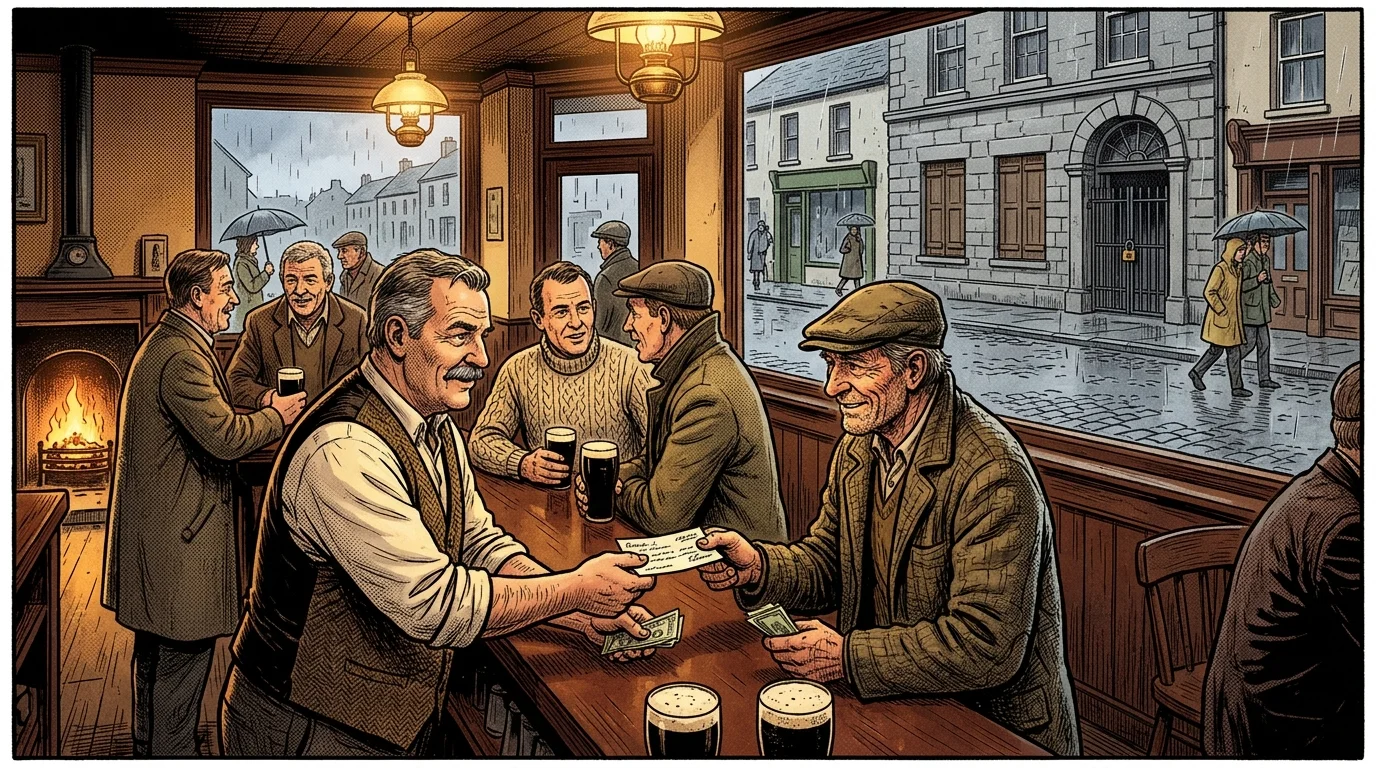
Rather than lapse into barter or deflationary paralysis, the Irish public improvised a peer-to-peer private paper currency. As Trinity College Dublin economist Antoin E. Murphy documented in his classic 1978 study Money in an Economy Without Banks: The Case of Ireland, households and businesses began writing undated and post-dated personal cheques drawn on their frozen bank accounts and endorsing them over to third, fourth, and fifth parties as circulating media of exchange. When pre-printed bank checkbooks were exhausted, transactors wrote negotiable IOUs on blank slips of paper, brown envelopes, cigar boxes, and even pub beer mats, affixing two-pence revenue or postage stamps to make them legally valid bills of exchange. [6]
The linchpin of this spontaneous monetary order was local informational symmetry. In 1970, the Republic of Ireland had roughly 11,000 pubs and 12,000 retail grocery and drapery shops—nearly one pub for every 260 residents. Publicans and shopkeepers stepped directly into the shoes of commercial bank managers, discounting and accepting endorsed cheques for groceries, wages, and pints while holding bundles of paper claims in their safes until the strike ended. As Murphy famously observed, local publicans often possessed superior credit-risk information than distant bank loan officers because “one does not after all serve drink to someone for years without discovering something of his liquid resources.” When the Associated Banks finally reopened on November 17, 1970, clerks spent three months until February 1971 sorting and settling a mountain of roughly £5 billion in accumulated paper cheques—more than double Ireland’s annual national income—with remarkably few defaults aside from the failure of the already insolvent shipping firm Palgrave Murphy. [7]
The Central Bank Act 1971 and the 1976 Strike
The 1970 shutdown exposed glaring institutional weaknesses in Irish monetary governance. Since its creation under the Central Bank Act 1942, the Central Bank of Ireland had lacked comprehensive statutory authority to license commercial banks, enforce prudential liquidity ratios, or even hold the Irish government’s own primary Exchequer accounts, which had remained lodged with the private Bank of Ireland. On July 28, 1971, the Oireachtas enacted the Central Bank Act 1971 (Act No. 24 of 1971), which required all banking institutions to obtain a Central Bank license, empowered the regulator to inspect bank books and prescribe statutory asset-to-liability and liquidity ratios, and mandated the transfer of the Exchequer account to the Central Bank. [8]
When the IBOA launched a third nationwide strike from June 28 to September 6, 1976, both the state and the public were far better prepared. Expanding Non-Associated banks, building societies, post offices, and government emergency facilities kept currency circulating, while pubs and shops seamlessly resumed their informal cheque-clearing protocols for nine weeks until branches reopened. [9]
The March 1985 Collapse of AIB’s Insurance Corporation of Ireland
While the Central Bank Act 1971 modernized domestic banking oversight, it left a dangerous blind spot in the supervision of non-bank subsidiaries acquired by Irish clearing banks. Seeking to diversify into general, marine, and life insurance, Ireland’s largest banking group, Allied Irish Banks plc (AIB), paid IR£10.2 million in 1981 for a 25 percent stake in the Dublin-listed Insurance Corporation of Ireland plc (ICI, founded in 1935) and in July 1983 acquired the remaining 75 percent of ICI’s shares, bringing AIB’s total equity investment to IR£86 million.
Unbeknownst to AIB’s board at the time of the takeover, ICI’s London branch office had aggressively expanded into high-risk international marine, aviation, and general reinsurance syndicates throughout the early 1980s, booking premium income while concealing massive underwriting liabilities and operating below its statutory solvency reserve ratio. By early 1985, internal reviews revealed that ICI was insolvent, with initial loss estimates jumping from IR£61 million past IR£100 million—and eventually calculated by High Court administrator William McCann of Craig Gardner at nearly IR£300 million (over IR£226 million in net deficit).
On March 8, 1985, AIB executives informed Taoiseach Garret FitzGerald’s Fine Gael–Labour coalition government and the Central Bank of Ireland that AIB could not inject further capital into ICI. Crucial to the panic was a cross-default vulnerability: Dr. FitzGerald and Central Bank officials learned that AIB’s international subordinated loan notes contained covenants allowing foreign creditors to demand immediate repayment if any subsidiary of AIB became insolvent. As FitzGerald later recalled, an unmanaged bankruptcy at ICI “could bring down the bank and finish the whole system.”
Weekend Nationalization, Statutory Administration, and the 1993 Settlement
Moving in strict secrecy to prevent a Monday morning run on AIB branches, the Irish government executed an emergency rescue after the Dublin Stock Exchange closed on Friday, March 15, 1985, ahead of the St. Patrick’s Day bank holiday weekend. The Minister for Industry, Trade, Commerce and Tourism acquired 100 percent of ICI’s shares from AIB for a nominal sum through a state holding company, Sealúchais Árachais Teoranta, and petitioned the High Court to place ICI into statutory administration under William McCann pursuant to the Insurance (No. 2) Act 1983. On April 8, 1985, the Oireachtas enacted the Insurance (Miscellaneous Provisions) Act 1985 (Act No. 8 of 1985), formally authorizing the ministerial share takeover and providing state guarantees for ICI’s policy liabilities.
To shield taxpayers from bearing the full cost of rescuing AIB’s subsidiary, the government and the Central Bank required AIB to write off its entire IR£90 million investment and related costs in its 1985 accounts, advance a subsidized IR£50 million loan at 4 percentage points below market rates, and subsequently place a 15-year, IR£70 million below-market deposit with the Central Bank alongside an annual banking-sector levy to fund ICI’s run-off vehicle, Icarom plc. In October 1993, on the eve of a High Court trial, ICI’s former auditors, Ernst & Whinney, agreed to pay US$110 million without admission of liability to settle negligence claims—split equally between Icarom’s administrator and AIB (which received IR£38.9 million)—allowing AIB to recognize a final pre-tax exceptional charge of IR£96.7 million in its 1993 accounts to close out the first systemic bank bailout in modern Irish history.
Theoretical & Balance-Sheet Transmission Mechanism
In the Kindleberger–Minsky taxonomy of financial instability (Kindleberger, 1978; Minsky, 1986) and Irving Fisher’s (1933) debt-deflation framework, speculative asset booms become systemic crises when credit expansion shifts balance sheets from hedge finance (cash flows covering principal and interest) to speculative and Ponzi finance (relying on rising asset prices and short-term margin roll-overs).
Once monetary tightening or an exogenous shock halts price appreciation, forced margin liquidations trigger Fisherian debt-deflation: fire-sale asset discounts erode bank collateral values, contracting credit supply across the real economy.
Sources and Further Reading
- Jason Lennard, Seán Kenny, and Emma Horgan, “Economic Effects of Runs and Closures: The Case of the Irish Bank Strike of 1966,” London School of Economics Economic History Working Paper No. 365, January 2024. Peer-Reviewed / Academic Research
- Jason Lennard, Seán Kenny, and Emma Horgan, “Banks and the Economy: Evidence from the Irish Bank Strike of 1966,” Centre for Macroeconomics (CFM) Discussion Paper 2402, 2024. Historical & Financial Reference
- Jesse Walker, “When the Irish Improvised a DIY Banking System,” Reason (citing Antoin E. Murphy’s study of the 1970 Irish bank strike), 2015-07-14. Historical & Financial Reference
- Houses of the Oireachtas, “Central Bank Act, 1971 (Act No. 24 of 1971),” electronic Irish Statute Book (eISB), 1971-07-28. Central Bank / Monetary Authority
- Houses of the Oireachtas, “Insurance (Miscellaneous Provisions) Act, 1985 (Act No. 8 of 1985),” electronic Irish Statute Book (eISB), 1985-04-08. Historical & Financial Reference
- Derry Cotter, “The Case of AIB and ICI 1985–1993: The Measurement and Disclosure of a Liability,” Irish Journal of Management 32, no. 2 (Maynooth University MURAL), 2013. Peer-Reviewed / Academic Research
- Simon Carswell, “AIB and ICI: why the State once bailed out Ireland’s biggest bank,” The Irish Times, 2011-09-30. Historical & Financial Reference
- Irving Fisher — "The Debt-Deflation Theory of Great Depressions," Econometrica 1, no. 4 (FRASER Federal Reserve Archive, 1933): 337–357 Central Bank / Monetary Authority
- Charles P. Kindleberger & Robert Z. Aliber — Manias, Panics, and Crashes: A History of Financial Crises (Palgrave Macmillan) Peer-Reviewed / Academic Research
Cite This Historical Dossier (APA / Chicago)
APA (7th ed.): Ç., S. (Ed.). (2026). Ireland's 1966–1976 Bank Strikes, Pub Cheque Clearing, and the 1985 ICI Collapse. In Forgotten Fortunes Historical Monograph Series (Forgotten Fortunes Editorial Desk). https://forgottenfortunes.net/irish-bank-strikes-ici-rescue/
MLA (9th ed.): Ç., Soner, ed. "Ireland's 1966–1976 Bank Strikes, Pub Cheque Clearing, and the 1985 ICI Collapse." Forgotten Fortunes: Financial & Monetary History Archive, 2026, https://forgottenfortunes.net/irish-bank-strikes-ici-rescue/.
Chicago (17th ed.): Ç., Soner, ed. "Ireland's 1966–1976 Bank Strikes, Pub Cheque Clearing, and the 1985 ICI Collapse." Forgotten Fortunes Historical Monograph Series (Forgotten Fortunes Editorial Desk), September 19, 2026. https://forgottenfortunes.net/irish-bank-strikes-ici-rescue/.
Have an idea for another financial history documentary or article? Request a story →