In This Article
Between 1953 and 1985, the People’s Republic of China governed its most vital physical commodities through an administrative apparatus designed to extract agricultural surpluses for heavy industry while insulating cities from price inflation. Beginning with Vice Premier Chen Yun’s November 1953 decree establishing Tonggou Tongxiao—the “Unified Purchase and Unified Sale” monopoly over grain and edible oils—Beijing outlawed private wholesale grain trading, compelled rural collectives to deliver fixed quotas at depressed state prices, and bound urban citizens to nearly four decades of paper ration coupons known as liangpiao. That domestic extraction engine was reinforced by the September 1959 discovery and 1960 “Great Battle” development of the giant Daqing oilfield in Heilongjiang, which broke China’s dependence on Soviet petroleum and later supplied the crude oil bartered for Japanese steel mills and industrial plants during the 1970s. Only after eighteen peasant households in Anhui’s Xiaogang Village secretly contracted collective land in December 1978 (baogan daohu) and reformist economists codified the dual-track pricing system (shuangguizhi) in 1984–1985 did China find a politically viable mechanism to grow out of the Soviet-style command plan without triggering an immediate price shock. [1]

The 1953 Grain Crisis and Chen Yun’s Tonggou Tongxiao Monopoly
When the People’s Republic of China launched its First Five-Year Plan in 1953, the state prioritized capital-intensive metallurgy, machinery, and defense construction modeled on the Soviet Union. Because China lacked access to Western capital markets and received only limited, repayable Soviet industrial credits, the accumulation of industrial capital had to be financed internally from agriculture. At the same time, rapid urban industrial recruitment expanded the non-agricultural payroll from roughly 16 million to nearly 20 million workers within two years, causing urban grain demand to surge faster than voluntary state market purchases could match. [2]
By the summer of 1953, a severe procurement shortfall emerged across the major grain-producing provinces. Private grain merchants and better-off peasant households held back harvests in anticipation of higher autumn prices, leaving state granaries short by several million metric tons and threatening price stability in major industrial centers such as Shanghai, Tianjin, and Shenyang. Tasked with resolving the fiscal and supply deadlock, Vice Premier Chen Yun, who chaired the Central Financial and Economic Commission, presented eight policy options to the Chinese Communist Party leadership in October 1953 before concluding that only compulsory procurement on the countryside paired with rationed distribution in the cities could sustain planned industrialization. [3]
On November 19, 1953, the Government Administration Council promulgated the historic “Order on the Implementation of Planned Purchase and Planned Supply of Grain,” universally known as Tonggou Tongxiao (Unified Purchase and Unified Sale). The decree immediately banned private merchants from wholesale grain trading and required peasant households to sell all “surplus” grain—calculated after strict official deductions for seed, animal feed, and basic subsistence—exclusively to state grain bureaus at fixed administrative prices. Within months, the compulsory procurement regime was extended to edible vegetable oils and, in September 1954, to raw cotton and cotton cloth. By enforcing a deliberate “price scissors” (jiandaocha)—holding state agricultural procurement prices low while pricing state-manufactured industrial goods high—Beijing transferred tens of billions of yuan in implicit rural value into state industrial enterprise profits and budgetary revenues. [4]
Living by the Coupon: Liangpiao, Bupiao, and the Hukou Wall
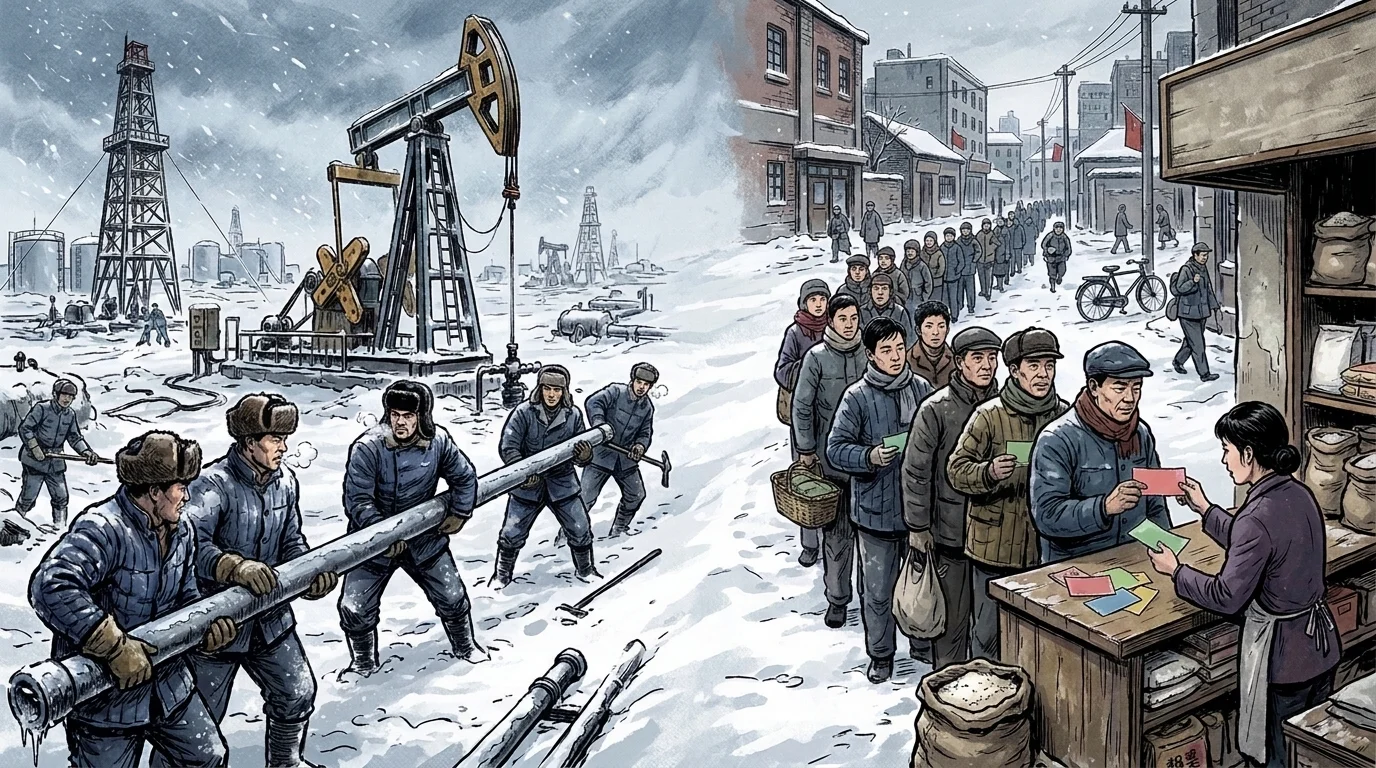
Controlling the rural harvest required an equally rigid mechanism to ration urban consumption. In August 1955, the State Council formalized the “Provisional Measures for the Rationed Supply of Grain in Cities and Towns,” replacing local temporary certificates with a nationwide system of paper grain coupons (liangpiao) issued by the Ministry of Food and provincial grain bureaus. Under this regime, renminbi banknotes alone could not purchase steamed buns, rice, noodles, or cooking oil in state stores or workplace canteens; buyers had to tender both cash and the exact weight denomination of liangpiao, measured in jin (500 grams) or liang (50 grams). [5]
Monthly grain rations were stratified precisely by occupation, age, and physical exertion. Heavy manual laborers in coal mines and steelworks received up to 45 to 55 jin (22.5 to 27.5 kilograms) of grain per month, ordinary urban office clerks and teachers received roughly 28 to 32 jin, university students received around 35 jin, and children were allotted tiered rations according to age brackets. Alongside liangpiao, urban households navigated an intricate portfolio of commodity tickets: cotton cloth coupons (bupiao, which at their tightest in the early 1960s rationed citizens to just a few feet of fabric per year), edible oil tickets (often restricting urban residents to 250 grams of cooking oil per month), meat tickets, soap tickets, and industrial vouchers for bicycles, sewing machines, and wristwatches. [6]
Beyond rationing calories, liangpiao functioned as an invisible internal passport that reinforced the 1958 Household Registration Regulation (hukou). Because municipal grain coupons were valid only within the issuing city or province—and converting local coupons into “national grain coupons” (quanguo liangpiao) required an official work-unit travel letter—rural peasants who lacked urban hukou entitlement could not legally obtain food in cities. During the catastrophic Great Leap Forward famine of 1959–1961, when exaggerated harvest reports led state cadres to procure excessive grain quotas from the countryside, the combination of compulsory tonggou requisitions and the urban hukou–liangpiao barrier left rural communes bearing the overwhelming brunt of starvation while urban industrial rations, though cut, were prioritized by the central state. [7]
The 1959–1960 Daqing Oilfield Breakout and Strategic Autarky
While grain and cotton dominated agricultural planning, petroleum represented the sharpest industrial bottleneck of the early People’s Republic. In 1949, China produced a negligible 120,000 metric tons of crude oil—mostly from the small Yumen field in Gansu and shale oil plants in Fushun—forcing the country to rely on imports from the Soviet Union for more than half of its military and industrial fuel. Western and Soviet geologists had long categorized eastern China’s continental sedimentary basins as “oil-poor,” leaving Beijing strategically exposed when ideological tensions with Moscow escalated in the late 1950s. [8]
Working from continental oil-generation theories developed by Chinese geologists including Li Siguang and Huang Jiqing, exploration teams from the Ministry of Petroleum Industry shifted their drilling rigs to the Songliao Basin in Heilongjiang Province. On September 26, 1959—days before the tenth anniversary of the founding of the People’s Republic—the exploratory well Songji-3 near Datong town struck a high-yielding commercial flow of crude oil. Renamed Daqing (“Great Celebration”), the structure proved to be a supergiant continental sandstone oilfield holding billions of barrels of recoverable reserves.
In February 1960, as Nikita Khrushchev’s government moved toward withdrawing Soviet technical specialists and curtailing petroleum deliveries, the CCP Central Committee authorized an all-out “Great Battle for Oil” (Shiyou Dahuizhan) at Daqing. Over 40,000 demobilized People’s Liberation Army soldiers, petroleum engineers, and workers—epitomized in state campaigns by drilling team leader “Iron Man” Wang Jinxi—converged on the frozen Manchurian steppe at temperatures dropping below minus 30 degrees Celsius. Living in earthen dugouts (gandalei) and hauling drilling rigs with ropes and crowbars in the absence of heavy cranes, crews produced 970,000 metric tons of crude oil in 1960 alone. By December 1963, with Daqing outputting over 6 million metric tons annually, Premier Zhou Enlai declared to the National People’s Congress that China’s era of dependence on “foreign oil” (yangyou) was permanently over.
Oil-for-Steel Barter: Daqing Crude and the 1978 Baoshan Pact
By the early 1970s, Daqing’s output climbed past 30 million metric tons toward its 50-million-ton plateau, transforming China from an autarkic consumer into a net petroleum exporter across East Asia. That surplus coincided with the January 1973 approval of the “Four-Three Scheme” (Si-San Fang’an)—a US$4.3 billion program championed by Zhou Enlai and later overseen by Deng Xiaoping to import complete chemical fertilizer plants, synthetic fiber complexes, and steel rolling mills from Japan, West Germany, the United States, and Western Europe—and with the October 1973 global oil shock, which left resource-poor Japan desperate for low-sulfur crude oil.
Daqing crude became Beijing’s hard-currency lifeline. In February 1978, Beijing and Tokyo signed the China–Japan Long-Term Trade Agreement (1978–1985), a US$20 billion bilateral barter framework under which China pledged to export 47.1 million metric tons of Daqing crude oil and over 8 million tons of coking and steam coal to Japan in exchange for turnkey Japanese industrial plants and metallurgical technology. Following Deng Xiaoping’s October 1978 tour of Nippon Steel’s automated Kimitsu Works, China broke ground in December 1978 on the modern Baoshan Iron and Steel Complex near Shanghai. Although stagnating oil output at mature fields in 1979–1980 briefly forced Chen Yun and the State Council to readjust and phase the Baoshan contracts, petroleum export earnings financed the technological bridge between Maoist self-reliance and post-1978 industrial modernization.
Xiaogang Village (1978) and the Dual-Track Price Reform (1984–1985)
The dismantling of the rigid commodity monopoly began where it had started: in the grain fields. After two decades of collective people’s communes, per capita grain production in China in 1977 barely exceeded the level of 1957, and rural poverty remained endemic across provinces like Anhui. On a winter night in December 1978—just as the Third Plenum of the 11th CCP Central Committee met in Beijing—eighteen peasant household heads in Xiaogang Production Team, Fengyang County, Anhui Province, pressed their red thumbprints onto a secret pact. Under their arrangement, known as baogan daohu (“contracting output quotas to the household”), families divided collective plots for individual cultivation, pledging to deliver their statutory state grain quota and collective dues while retaining 100 percent of any surplus harvest—and vowing to raise the children of village cadres if any leader was imprisoned for the illegal experiment.
The incentive effect was immediate: in 1979, Xiaogang Village harvested 66,000 kilograms of grain—four times its previous annual average—and delivered more compulsory grain to the state in a single year than it had between 1956 and 1970 combined. Backed by Anhui Party Secretary Wan Li and endorsed by Deng Xiaoping in 1980, the Household Responsibility System swept the Chinese countryside, encompassing over 98 percent of rural production teams by 1983 and lifting national grain output from 304.8 million metric tons in 1978 to a record 407.3 million metric tons in 1984.
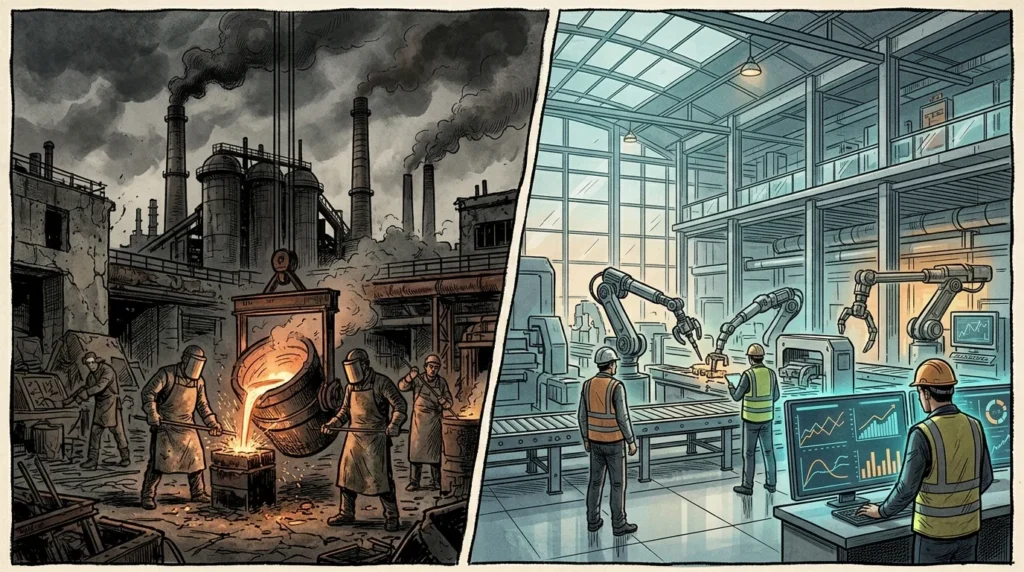
To extend this marginal-incentive logic to industry without triggering post-Soviet style collapse, young economists at the September 1984 Moganshan Conference in Zhejiang—and the State Council in its October 1984 “Decision on Reform of the Economic Structure” and January 1985 directives—codified the Dual-Track Pricing System (shuangguizhi). Under shuangguizhi, a single commodity such as steel, coal, cement, or chemical fertilizer simultaneously carried two legal prices: a lower “plan price” for fixed mandatory state quotas and a flexible “market price” for all above-quota production. In January 1985, CCP Central Document No. 1 formally abolished mandatory tonggou grain procurement after thirty-two years, replacing it with state contract purchasing paired with open-market sales. Although dual-track price spreads bred widespread arbitrage and official profiteering (guandao) in the late 1980s, the mechanism allowed China’s non-state sector to expand at market prices on the margin until over 90 percent of retail and industrial commodities were fully market-priced by 1993, when Beijing finally retired the last liangpiao grain coupons.
Theoretical & Balance-Sheet Transmission Mechanism
In the Kindleberger–Minsky taxonomy of financial instability (Kindleberger, 1978; Minsky, 1986) and Irving Fisher’s (1933) debt-deflation framework, speculative asset booms become systemic crises when credit expansion shifts balance sheets from hedge finance (cash flows covering principal and interest) to speculative and Ponzi finance (relying on rising asset prices and short-term margin roll-overs).
Once monetary tightening or an exogenous shock halts price appreciation, forced margin liquidations trigger Fisherian debt-deflation: fire-sale asset discounts erode bank collateral values, contracting credit supply across the real economy.
Sources and Further Reading
- Yuhua Guo, “ Food and Politics: The State System of Unified Purchase and Unified Sale,” University of Ottawa Press, 2021. Historical & Financial Reference
- Common Program Historical Archive, “ Article 37: Commerce and the 1953 Unified Purchase and Marketing System,” CommonProgram.science, 2020. Historical & Financial Reference
- Chengzao Jia et al., “ Discovery of Daqing Oilfield and the Development of Continental Petroleum Geology in China,” AAPG Search and Discovery, 2018. Historical & Financial Reference
- Ryosei Kokubun, “ The Politics of Foreign Economic Policy-Making in China: The Case of Plant Cancellations with Japan,” Japan Institute of International Affairs, 2017. Historical & Financial Reference
- Gang Fan and Wing Thye Woo, “ State Enterprise Reforms as a Source of Macroeconomic Instability: The Case of China,” Peterson Institute for International Economics, 1996. Historical & Financial Reference
- China.org.cn, “ 1985: Price Reform and the Dual-Track System,” China Internet Information Center, 2009. Historical & Financial Reference
- Irving Fisher — "The Debt-Deflation Theory of Great Depressions," Econometrica 1, no. 4 (FRASER Federal Reserve Archive, 1933): 337–357 Central Bank / Monetary Authority
- Charles P. Kindleberger & Robert Z. Aliber — Manias, Panics, and Crashes: A History of Financial Crises (Palgrave Macmillan) Peer-Reviewed / Academic Research
Cite This Historical Dossier (APA / Chicago)
APA (7th ed.): Ç., S. (Ed.). (2026). Tonggou Tongxiao, Daqing Oil, and China's Dual-Track Commodity Revolution (1953–1985). In Forgotten Fortunes Historical Monograph Series (Forgotten Fortunes Editorial Desk). https://forgottenfortunes.net/tonggou-tongxiao-china-grain-monopoly/
MLA (9th ed.): Ç., Soner, ed. "Tonggou Tongxiao, Daqing Oil, and China's Dual-Track Commodity Revolution (1953–1985)." Forgotten Fortunes: Financial & Monetary History Archive, 2026, https://forgottenfortunes.net/tonggou-tongxiao-china-grain-monopoly/.
Chicago (17th ed.): Ç., Soner, ed. "Tonggou Tongxiao, Daqing Oil, and China's Dual-Track Commodity Revolution (1953–1985)." Forgotten Fortunes Historical Monograph Series (Forgotten Fortunes Editorial Desk), September 15, 2026. https://forgottenfortunes.net/tonggou-tongxiao-china-grain-monopoly/.
Have an idea for another financial history documentary or article? Request a story →