In This Article
In May 1998, five underground nuclear detonations in the Thar Desert of Rajasthan thrust India into an acute financial and strategic test. Within forty-eight hours of the Pokhran-II tests, the United States, Japan, and several European governments invoked nonproliferation statutes to freeze bilateral economic aid, suspend export credit guarantees, and block non-humanitarian loans from the World Bank and the Asian Development Bank. Coming less than a year after the 1997 Asian Financial Crisis had roiled emerging-market currencies across East and Southeast Asia, the sudden withdrawal of official external financing threatened to trigger capital flight, rating downgrades, and a balance-of-payments squeeze. [1]
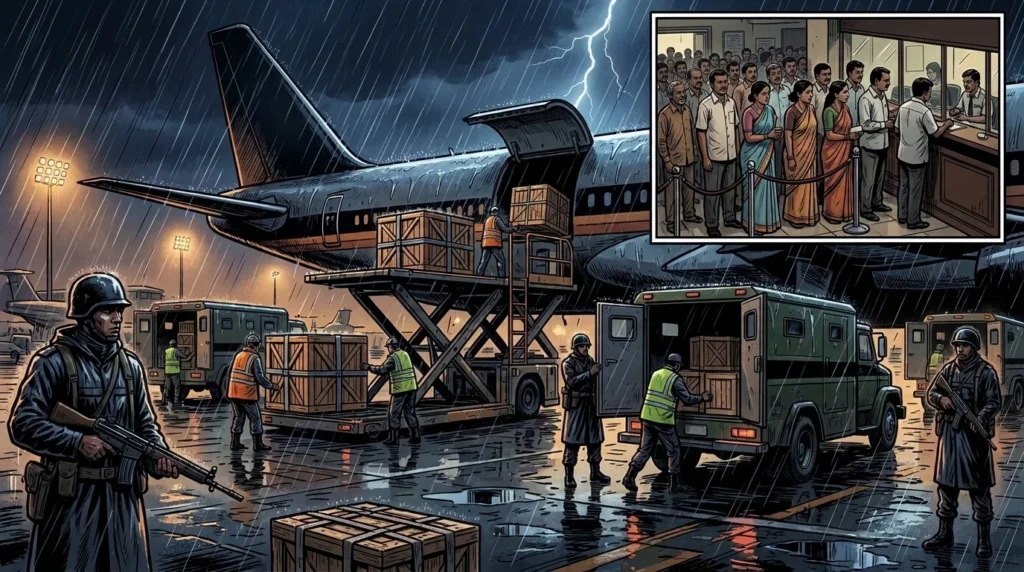
Rather than retreating into autarky or accepting punitive sovereign borrowing spreads in Western capital markets, the Reserve Bank of India (RBI) and the State Bank of India (SBI) engineered an unconventional financial bypass. In August 1998, SBI launched five-year foreign-currency Resurgent India Bonds (RIBs) aimed exclusively at Non-Resident Indians (NRIs), raising $4.23 billion in hard currency and fortifying central bank reserves. Less than a year later, when the May–July 1999 Kargil conflict along the Line of Control in Kashmir exposed severe operational and equipment shortfalls, that external financial buffer enabled New Delhi to absorb emergency wartime expenditures, enact a 28.2 percent single-year jump in its 2000–2001 defense budget, and initiate long-term procurement reforms that culminated in the post-2020 Atmanirbhar Bharat defense indigenization drive. [2]
The May 1998 Pokhran-II Tests and Glenn Amendment Sanctions
On May 11 and May 13, 1998, under the codename Operation Shakti, Indian scientists conducted five underground nuclear explosions—including a thermonuclear device and four fission devices—at the Pokhran test range in Rajasthan. Prime Minister Atal Bihari Vajpayee declared India a full-fledged nuclear weapon state. Two weeks later, on May 28 and May 30, neighboring Pakistan responded with its own underground nuclear tests in the Chagai Hills of Balochistan. [3]
In Washington, the tests triggered mandatory statutory penalties under Section 102 of the Arms Export Control Act, widely known as the 1994 Glenn Amendment. President Bill Clinton formally signed the sanctions determination against India on May 13, 1998. The Glenn Amendment required the immediate termination of non-humanitarian foreign assistance under the Foreign Assistance Act, the suspension of U.S. government military sales and dual-use technology licenses, a ban on credit or financial guarantees from U.S. federal agencies—including the Export-Import Bank (Ex-Im Bank), the Overseas Private Investment Corporation (OPIC), and the Trade and Development Agency (TDA)—and a prohibition on U.S. commercial bank loans directly to the Government of India. [4]
Most consequentially for India’s infrastructure and fiscal planning, the Glenn Amendment required the United States to oppose any non-humanitarian loan or technical assistance to India by international financial institutions. Joined by Japan—which froze new grant aid and suspended yen loan commitments through its Overseas Economic Cooperation Fund (OECF)—and supported by fellow G8 members, the United States forced the postponement of more than $1.5 billion in pending World Bank power, highway, and industrial projects. Altogether, analysts at the Carnegie Endowment for International Peace and the Institute for International Economics estimated that bilateral and multilateral suspensions froze or delayed between $2.5 billion and $3.5 billion in scheduled capital flows, while sovereign credit rating agencies lowered India’s foreign-currency debt outlook amid fears that the Indian rupee (then trading near ₹40 to ₹42 per US dollar) would suffer speculative contagion. [5]
| Documented Figure / Metric | Historical Significance & Archival Context |
|---|---|
| ₹48,504 crore | During the 1999 fighting, India's Ministry of Defence was forced to execute emergency fast-track imports from Israel, Russia, France, and South Africa at premium prices, pushing actual defense spending in fiscal year 1999–2000 to ₹48,504 crore—well above the initial budget estimate of ₹45,694 crore. |
| 60 percent | Despite the post-Kargil institutional reforms, India remained the world's largest importer of major conventional weapons throughout the 2000s and 2010s, with foreign vendors absorbing more than 60 percent of the military's capital acquisition budget. |
State Bank of India’s $4.23 Billion Resurgent India Bonds
Confronted with hostile international bond markets and frozen multilateral pipelines, Finance Minister Yashwant Sinha and Reserve Bank of India Governor Bimal Jalan turned to India’s global diaspora. Unlike South Korea or Indonesia in 1997, India maintained strict controls on short-term corporate external debt, meaning it faced no immediate rollover panic; however, the government needed a decisive infusion of medium-term foreign exchange to reassure currency markets and finance oil and capital-goods imports. [6]
Because the State Bank of India was a commercial banking corporation rather than the sovereign Government of India itself, debt instruments issued by SBI fell outside the strict statutory ban on U.S. commercial bank dealings with the Indian state. On August 5, 1998, with the formal approval of the Ministry of Finance and the RBI, the State Bank of India opened subscriptions for Resurgent India Bonds (RIBs). These five-year bank instruments were restricted to Non-Resident Indians, Persons of Indian Origin, and Overseas Corporate Bodies acting predominantly through diaspora networks across the Persian Gulf, North America, Europe, and Southeast Asia. [7]
SBI structured the Resurgent India Bonds across three convertible currencies with attractive tax-free interest rates that exceeded prevailing Western deposit yields while remaining cheaper than punitive emerging-market sovereign spreads: 7.75 percent per annum on US dollar bonds, 8.00 percent on British pound sterling bonds, and 6.25 percent on Deutsche mark bonds. Crucially, the Government of India and the Reserve Bank of India agreed to bear the foreign-exchange valuation risk through a dedicated Maintenance of Value account, insulating SBI from rupee depreciation over the five-year maturity. [8]
Despite initial skepticism from foreign investment banks, the August 1998 offering closed oversubscribed at $4.23 billion in foreign-currency proceeds. SBI retained a fraction in foreign accounts for international operations and sold the vast majority of the hard-currency proceeds directly to the Reserve Bank of India in exchange for rupees, which were then invested in government securities and infrastructure lending. The $4.23 billion inflow immediately lifted India’s foreign exchange reserves above $29 billion, stabilized the rupee, and demonstrated that New Delhi could tap diaspora savings whenever official Western credit channels closed. By October 1998, recognizing that sanctions were hurting American agricultural and industrial exporters more than India’s macroeconomy, the U.S. Congress enacted the Brownback Amendment (the India-Pakistan Relief Act), empowering President Clinton to waive Ex-Im Bank, OPIC, and multilateral lending restrictions.
The RBI and SBI repeated the diaspora bond playbook in October and November 2000 when rising global crude oil prices again pressured India’s current account. Under RBI Exchange Control Circular No. 18 of October 19, 2000, SBI floated five-year India Millennium Deposits (IMDs) carrying an 8.50 percent US dollar coupon, mobilizing an additional $5.51 billion. When the original Resurgent India Bonds matured on October 1, 2003, the Reserve Bank of India seamlessly sold $5.185 billion in foreign exchange ($2.794 billion from forward receivables and $2.391 billion from spot reserves) to SBI to redeem the entire principal and accumulated interest on schedule without market volatility.
The 1999 Kargil War and the 2000–2001 Defense Budget Surge
The financial resilience secured by the Resurgent India Bonds was tested sooner than policymakers anticipated. In May 1999, Indian patrols discovered that Pakistani regular troops from the Northern Light Infantry and irregular forces had covertly infiltrated across the Line of Control in the Kargil, Dras, Batalik, and Mashkoh sectors of Jammu and Kashmir, seizing fortified mountain ridges overlooking National Highway 1A—the vital supply artery linking Srinagar to Leh.
Between May and July 1999, India waged Operation Vijay, a high-altitude conventional campaign fought at elevations between 14,000 and 18,000 feet. Deploying more than 30,000 troops, Mirage 2000 strike aircraft dropping laser-guided munitions, and over 250 Bofors FH-77B 155mm howitzers firing more than 250,000 shells, Indian forces recaptured the strategic peaks before hostilities concluded on July 26, 1999. The war claimed the lives of 527 Indian military personnel and wounded over 1,300.
Financially and logistically, the Kargil War exposed the consequences of a decade of defense budget compression. Throughout the early and mid-1990s, following India’s 1991 balance-of-payments crisis, defense outlays had declined from 3.6 percent of GDP in the late 1980s to roughly 2.1 percent of GDP, deferring modernization of mountain warfare gear, weapon-locating radars, unmanned aerial vehicles, night-vision devices, and precision artillery shells. During the 1999 fighting, India’s Ministry of Defence was forced to execute emergency fast-track imports from Israel, Russia, France, and South Africa at premium prices, pushing actual defense spending in fiscal year 1999–2000 to ₹48,504 crore—well above the initial budget estimate of ₹45,694 crore.
When Finance Minister Yashwant Sinha presented the Union Budget for fiscal year 2000–2001 on February 29, 2000, the government delivered a historic fiscal correction: India’s defense allocation was raised by ₹13,000 crore in a single year to ₹58,587 crore (approximately $13.5 billion), representing a 28.2 percent increase over the previous year’s budget estimates. It was the largest single-year percentage jump in Indian defense spending since independence, designed to replenish depleted war wastage reserves, acquire Sukhoi Su-30MKI fighters, T-90S main battle tanks, and airborne early warning systems, and fund high-altitude surveillance along the Himalayan frontier.
The Kargil Review Committee and Procurement Overhaul
On July 29, 1999, three days after the end of combat operations, the Vajpayee cabinet constituted the four-member Kargil Review Committee (KRC) chaired by veteran defense analyst K. Subrahmanyam, alongside Lieutenant General K. K. Hazari, journalist B. G. Verghese, and National Security Council Secretariat Secretary Satish Chandra. Tabled in Parliament in February 2000, the KRC report documented systemic flaws not only in intelligence sharing and border surveillance, but also in India’s fragmented defense budgeting, ad-hoc weapons acquisition, and over-reliance on foreign supply chains vulnerable to wartime embargoes and sanctions.
Acting on the KRC report, a Group of Ministers headed by Home Minister L. K. Advani submitted comprehensive national security recommendations in February 2001. In May 2001, the Cabinet Committee on Security approved the creation of the Integrated Defence Staff (IDS), the Defence Intelligence Agency (DIA), and a dedicated Defence Acquisition Council (DAC) chaired by the Defence Minister to centralize capital procurement decisions. The government also issued formal Defence Procurement Procedures (beginning in 2002) to standardize trials, offsets, and multi-year capital acquisitions, laying the institutional groundwork that later culminated in the appointment of India’s first Chief of Defence Staff (CDS) and the Department of Military Affairs in December 2019.
Atmanirbhar Bharat and the Domestic Defense Industrial Pivot
Despite the post-Kargil institutional reforms, India remained the world’s largest importer of major conventional weapons throughout the 2000s and 2010s, with foreign vendors absorbing more than 60 percent of the military’s capital acquisition budget. Repeated procurement delays, unspent capital allocations, and strategic vulnerability to external supply disruptions prompted a decisive structural shift beginning in May 2020 under the Atmanirbhar Bharat (Self-Reliant India) initiative.
Under the revised Defence Acquisition Procedure (DAP) 2020, the Ministry of Defence introduced a new “Buy (Indian-IDDM)” (Indigenously Designed, Developed and Manufactured) category as the highest-priority procurement tier, mandated minimum indigenous content thresholds of 50 to 60 percent across acquisition categories, and raised the foreign direct investment (FDI) cap in defense manufacturing to 74 percent under the automatic route. Simultaneously, the Ministry began publishing sequential “Positive Indigenisation Lists”—eventually covering more than 5,000 line-replacement units, subsystems, artillery guns, light combat helicopters, sonar systems, and corvettes—imposing binding timelines after which the armed forces were legally barred from importing listed items.
Most importantly, the government ring-fenced the military capital budget itself. Having reserved 58 percent of the capital procurement budget for the domestic industry in FY 2020–21 and 68 percent in FY 2022–23, the Ministry of Defence earmarked a record 75 percent of the capital acquisition budget—roughly ₹1 lakh crore out of the modernization outlay—exclusively for procurement from domestic Indian companies in FY 2023–24 and FY 2024–25, with a quarter of that domestic pool reserved for private-sector Indian manufacturers, MSMEs, and defense startups supported by the Innovations for Defence Excellence (iDEX) framework. In October 2021, the government also dissolved the two-century-old Ordnance Factory Board, converting its 41 state arsenals into seven corporate public-sector undertakings.
The fiscal and industrial impact was measurable across both production and trade balances. Value of indigenous defense production climbed from ₹46,429 crore in FY 2014–15 to over ₹1.27 lakh crore in FY 2023–24, while annual Indian defense exports—which stood at just ₹686 crore in FY 2013–14—surged more than thirty-fold to reach ₹21,083 crore (approximately $2.63 billion) in FY 2023–24 and continued climbing thereafter. Exporting BrahMos supersonic cruise missiles to the Philippines, Dornier-228 aircraft, artillery systems, Pinaka multi-barrel rocket launchers, and avionics components to more than 85 countries, India transformed the vulnerability exposed by the 1998 Pokhran sanctions and the 1999 Kargil War into a domestically anchored defense-industrial finance model.
Theoretical & Balance-Sheet Transmission Mechanism
In the Kindleberger–Minsky taxonomy of financial instability (Kindleberger, 1978; Minsky, 1986) and Irving Fisher’s (1933) debt-deflation framework, speculative asset booms become systemic crises when credit expansion shifts balance sheets from hedge finance (cash flows covering principal and interest) to speculative and Ponzi finance (relying on rising asset prices and short-term margin roll-overs).
Once monetary tightening or an exogenous shock halts price appreciation, forced margin liquidations trigger Fisherian debt-deflation: fire-sale asset discounts erode bank collateral values, contracting credit supply across the real economy.
Sources and Further Reading
- Daniel Morrow and Michael Carriere, “The Economic Impacts of the 1998 Sanctions on India and Pakistan,” The Nonproliferation Review, Fall 1999. Peer-Reviewed / Academic Research
- Reserve Bank of India, “Redemption of Resurgent India Bonds,” RBI Press Release, October 1, 2003. Historical & Financial Reference
- Reserve Bank of India, “India Millennium Deposits (IMDs) — A.P. (DIR Series) Circular No. 18,” RBI Foreign Exchange Department, October 19, 2000. Historical & Financial Reference
- United Service Institution of India, “Kargil Conflict, National Security Management, and Defence Budgeting,” USI Journal, Vol. CXXX, January–March 2000. Historical & Financial Reference
- All India Radio (Akashvani News), “Transforming India’s Defence Sector: The Impact of Atma Nirbhar Bharat Initiative,” Prasar Bharati, October 29, 2024. Official / State Archive
- Dinakar Peri, “India to spend 75% of defence capital outlay for procurement from domestic firms: Rajnath,” The Hindu, February 15, 2023. Historical & Financial Reference
- Irving Fisher — "The Debt-Deflation Theory of Great Depressions," Econometrica 1, no. 4 (FRASER Federal Reserve Archive, 1933): 337–357 Central Bank / Monetary Authority
- Charles P. Kindleberger & Robert Z. Aliber — Manias, Panics, and Crashes: A History of Financial Crises (Palgrave Macmillan) Peer-Reviewed / Academic Research
Cite This Historical Dossier (APA / Chicago)
APA (7th ed.): Ç., S. (Ed.). (2026). From Pokhran Sanctions and Resurgent India Bonds to Post-Kargil Defense Finance. In Forgotten Fortunes Historical Monograph Series (Forgotten Fortunes Editorial Desk). https://forgottenfortunes.net/india-1998-resurgent-india-bonds/
MLA (9th ed.): Ç., Soner, ed. "From Pokhran Sanctions and Resurgent India Bonds to Post-Kargil Defense Finance." Forgotten Fortunes: Financial & Monetary History Archive, 2026, https://forgottenfortunes.net/india-1998-resurgent-india-bonds/.
Chicago (17th ed.): Ç., Soner, ed. "From Pokhran Sanctions and Resurgent India Bonds to Post-Kargil Defense Finance." Forgotten Fortunes Historical Monograph Series (Forgotten Fortunes Editorial Desk), September 13, 2026. https://forgottenfortunes.net/india-1998-resurgent-india-bonds/.
Have an idea for another financial history documentary or article? Request a story →